
GRP vs Steel: When We Recommend using GRP for Custom Industrial Components
Compared to steel, there are many situations that call for a more flexible, lightweight material, where GRP is appropriate.
For specifiers comparing steel against GRP (glass reinforced plastic or fibreglass), the useful question is rarely which material is better in the abstract. Instead, consider whether the component's purpose, environment, geometry and production route make it better suited for a composite moulded part.
In many industrial applications, the material decision often comes down to weight, corrosion exposure, and assembly complexity. The finish can also be important, as it may need to match existing colours, and gel is a low-cost option for colouring fibreglass. Consider the properties that should be built into the part at the design stage.
Because the fibre, resin and laminate layout can all be selected for the application, GRP can be engineered around a specific brief rather than treated as a direct substitute for sheet steel or aluminium. That is why it is often specified for custom machine covers, enclosures, housings, guards and external panels in industrial settings.
At Quantum, we work with industrial manufacturers to assess whether GRP is the right engineered solution for custom components. Our evaluation centres on whether GRP:
- reduces weight
- avoids corrosion-related maintenance
- simplifies part geometry
- or improves repeat manufacture
- and can meet the application requirements
Composition of GRP
GRP combines glass fibres with resin, typically polyester, vinyl ester or epoxy. The glass fibre when mixed with the resin gives significant strength and can support other properties depending on the resin used.
Unlike steel, GRP is not isotropic. Its behaviour depends on fibre type, fibre orientation, laminate schedule and resin choice, so the required characteristics need to be designed in.
Properties of GRP for industrial design
When engineers assess GRP for industrial components, some of the most relevant factors include:
- density and resulting component weight
- specific stiffness and specific strength
- corrosion behaviour in the actual service environment
- electrical insulation requirements
- mouldability for complex geometry
- repeatability across production volumes
- finish, surface quality and integration of cosmetic requirements
These are some of the factors that determine whether GRP is a sound engineered choice, rather than simply a lighter material on paper.
Steel
Steel remains the benchmark for many industrial components because it offers high absolute strength, established design data and straightforward fabrication for simple geometries. It also carries a significant density penalty, and in corrosive or washdown environments it often depends on coatings, finishing systems or grade upgrades to maintain service life.
Standard Plastics
Standard industrial plastics such as ABS, polypropylene and polyethylene can be useful for low-load housings and simple moulded parts, but they do not automatically offer the same stiffness or scale-up potential as a well-designed GRP laminate. The surface finish is very limited and may need additional post manufacturing processes to achieve the aesthetic requirements which adds cost.
For larger machine covers, enclosures and access structures, the comparison is often less about plastics versus composites and more about whether a standard polymer part can meet the functional requirement, or whether an engineered laminate is needed.
Common applications across GRP, metal and industrial plastics include machine covers, equipment housings, enclosures, access panels, canopies and protective outer structures. The right material depends on the load case, environment and manufacturing route.
When to Use GRP Instead of Metal or Plastic
Material selection should start with the component's job in the assembly. Is it structural, semi-structural or primarily protective? Does it see washdown, chemicals, UV, impact or vibration? Does the geometry favour moulding, or is it simple enough that fabrication remains the better route?
GRP becomes a strong candidate when the component needs to be lighter than steel, more corrosion-tolerant than painted metal, more rigid than many standard plastics, or more geometrically integrated than a fabricated assembly. It is especially useful where one moulded part can replace several cut, folded and welded metal parts.
Typical decision factors include:
- component weight
- exposure to moisture, chemicals or weather
- stiffness and impact requirements
- part complexity
- production volume
- assembly time
- finish requirements
- lifecycle maintenance implications
GRP Is Lighter Than Steel
A key reason manufacturers investigate GRP is weight. Typical engineering data places steel at roughly 7.7 to 8.0 g/cm³, aluminium at about 2.7 g/cm³, and common glass-filled composite systems around 1.8 to 2.0 g/cm³, though exact GRP density depends on formulation and reinforcement content.
|
Material |
Typical density |
Design implication |
|---|---|---|
|
Steel |
7.7 to 8.0 g/cm³ |
Highest mass for a given volume |
|
Aluminium |
Lower mass, still metallic |
|
|
GRP |
1.8 to 2.0 g/cm³ |
Lower mass, formulation-dependent |
Lower density does not mean a GRP part can simply be made to the same section and expected to behave like steel. It means the engineer has more freedom to achieve the required stiffness and durability through a different geometry, laminate build-up and/or rib strategy, normally without adding weight. That is the important distinction in industrial component design.
This matters in components such as machine guards, access covers, operator canopies, equipment housings and enclosure doors, where reducing handling weight can make installation easier and lower the burden on hinges, fixings and supporting structures.
GRP vs Aluminium
GRP versus aluminium is usually a closer design conversation than GRP versus steel, because both materials are chosen when weight matters. Aluminium remains attractive where precise machining, high thermal conductivity, thin-section rigidity or conductive behaviour are required. GRP is often the stronger commercial choice where corrosion resistance, electrical insulation and moulded geometry are more important.
GRP may be the better fit where the part needs integrated ribs, radii, flanges or cosmetic surfaces straight from the mould, or where corrosion and washdown conditions make ongoing coating maintenance undesirable. Aluminium may still be the better fit for highly machined interfaces, elevated service temperatures or applications where a metallic datum structure is essential.
GRP vs Standard Plastics
Compared with many standard plastics, GRP gives the designer a more structural route. The combination of glass fibre reinforcement and thermoset resin can deliver higher stiffness and better dimensional stability for larger industrial panels and housings than would typically be expected from commodity polymer parts.
That makes GRP relevant where a component has to span openings, carry fittings, resist repeated handling or maintain shape over a larger footprint. Standard plastics still have a place, particularly for simple, smaller, low-load parts, but they are not always the right answer once panel size and functional integration increase.
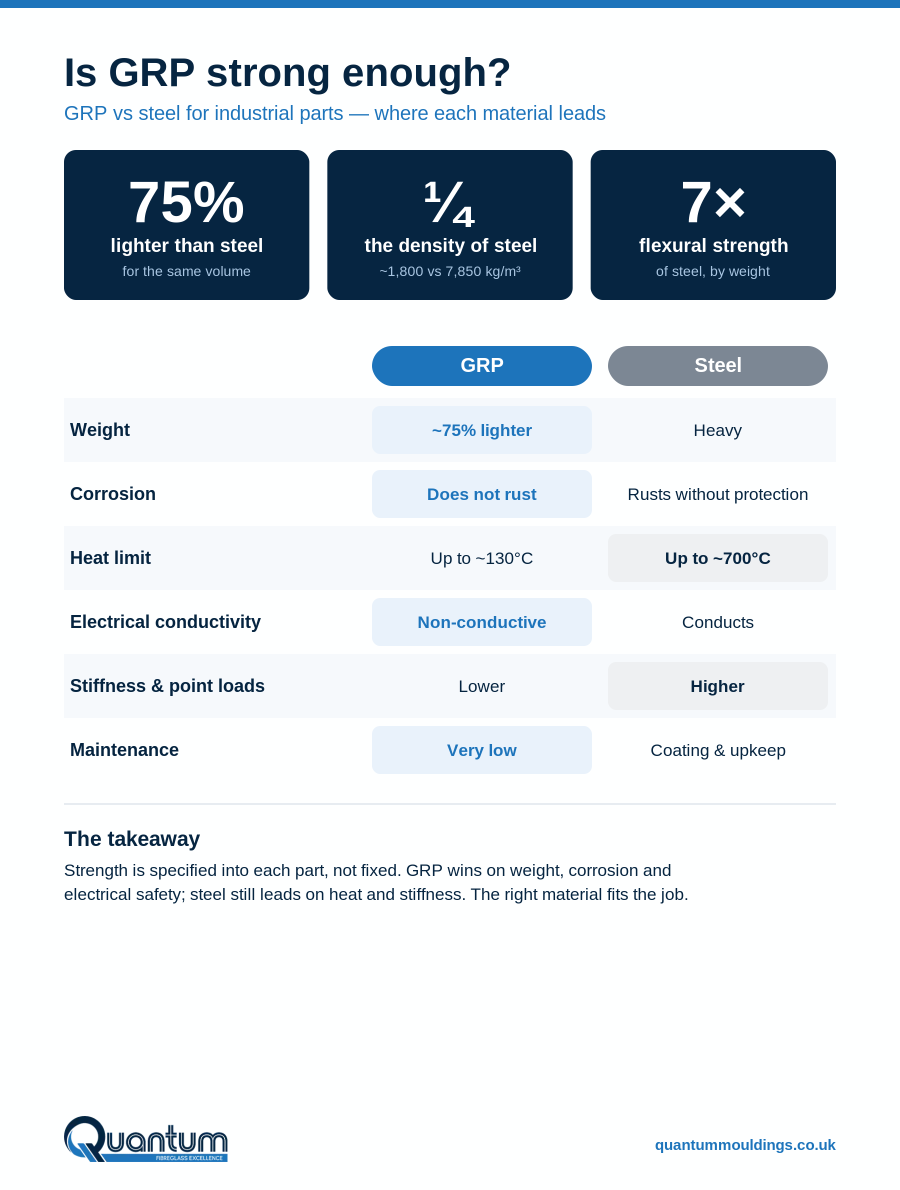
Is GRP Strong Enough for Industrial Use?
When we create GRP parts for industrial use, the laminate is designed around the actual load case. We work with clients to specify the type of fibre , laminate thickness, resin system, local reinforcement, and the direction of loading to meet the requirements of the application.
Because the strength and rigidity of GRP varies so greatly with different designs, there is no single answer to the question of how strong the material is in general. The real answers come from whether the designed GRP component can meet the required stiffness, strength and durability in service.
Steel will still outperform GRP in many high-load, high-temperature or heavily concentrated load applications. GRP offers a better engineering profile for parts with moderate structural duties, such as housings, guards, covers, access structures or enclosures. This is because GRP combines lower mass with corrosion resistance and design flexibility.
The engineering inputs that typically influence the strength of a GRP component are:
- laminate schedule
- wall thickness
- rib and flange design
- insert strategy
- support points
- impact requirement
- service temperature
- chemical exposure
- expected production volume
Is GRP Suitable for Outdoor, Wet or Chemical Environments?
Outdoor and UV exposure
GRP can be specified for outdoor industrial use, but this depends on choosing the right resin system and surface finish for the environment. UV stability is a design and materials selection issue, not a generic property of all composite systems.
Wet and corrosive environments
Where rust is a known failure mode or maintenance burden, GRP can present a clear advantage over carbon steel because the material itself does not corrode in the same way. That is one reason fibre-reinforced composites are well established in demanding environments where painted or coated metal would require ongoing maintenance.
Chemical resistance
Chemical resistance depends heavily on resin choice and the specific media involved. Glass-reinforced polyester systems can offer good to excellent resistance to acids, weak alkalis and organic solvents, while performance against strong alkalis requires careful resin selection. The chemical requirements should be reviewed at concept stage to ensure the correct products are known before making the prototype.
Impact and durability
GRP can be engineered for repeated industrial use. Since durability comes from the laminate design, it can be designed for the expected impacts or weathering factors, such as incidental knocks, repeated access, washdown, vibration or environmental cycling. If a gel surface is used, then the gel is more prone to damage but can also be repaired.
For example, industrial machine covers made from GRP are designed to withstand impacts from height, such as dropped materials.
GRP Tolerances and Dimensional Accuracy
Tolerances in GRP are achievable, but they need to be approached differently from machined metal parts. Process choice, tooling quality, cure control, geometry and trim strategy all influence final accuracy.
Critical interfaces should be identified early, so the component can be designed around realistic moulded tolerances, with secondary machining or bonded and moulded-in inserts used where tight local fit is needed.
Early design-for-manufacture input should cover:
- split lines and draft
- ribs and return flanges
- moulded versus machined features
- insert and fixing strategy
- cosmetic surfaces
- handling and trim allowances
- assembly datums
GRP Works Well for Custom Industrial Components
The best-fit applications for GRP in industrial assemblies are usually custom components where geometry and environment matter as much as raw load capacity. Examples include machine covers, enclosure shells, process equipment housings, operator canopies, access panels, duct covers and protective outer panels.
In these cases, GRP's value often comes from combining several functions in one moulded component: shape, stiffness, outer finish, corrosion resistance and local feature integration. That can reduce part count and cut fabrication steps compared with a built-up metal assembly.
Typical benefits include:
- bespoke moulded geometry
- reduced component weight
- corrosion resistance in the right environment
- integrated ribs and fixing features
- fewer fabricated sub-parts
- electrically insulating behaviour where required
- consistent repeat production from the same tool
Using GRP or Steel Depends on Design Specifications
|
Design element |
Favours GRP |
Favours metal |
|---|---|---|
|
Load type |
Semi-structural or protective parts |
Very high concentrated loads |
|
Stiffness |
— |
Thin-section stiffness is critical |
|
Weight |
Weight reduction matters |
— |
|
Corrosion |
Corrosion exposure is in the brief |
— |
|
Temperature |
Within the composite's working range |
Service temperatures above that range |
|
Electrical |
Insulation is useful |
Conductivity is required |
|
Heat |
— |
Heat transfer is required |
|
Geometry |
Shape suits moulding; several parts can merge into one moulding |
Shape is simple |
|
Tolerances |
— |
Tight machined tolerances |
|
Surface finish |
Finish matters |
— |
|
Production volume |
Repeatable enough to justify tooling |
Low enough that fabrication beats tooling cost |
That comparison should be made case by case. A sound specification process starts by defining the performance requirement, then selecting the material and manufacturing route that best meets it.
Working With Quantum on Custom Components
Quantum supports industrial GRP projects from early concept through to repeat manufacture. The most productive point of engagement is usually before geometry is frozen: when laminate strategy, fixing details, tooling approach and production assumptions can still be shaped around the application.
Support can include:
- design-for-manufacture guidance
- material and resin selection
- tooling strategy
- part consolidation opportunities
- tolerance planning
- repeat production support
Contact our team to discuss whether Quantum’s GRP mouldings are the right engineered solution for your custom component.
