Is GRP strong enough for industrial applications?
GRP, short for Glass Reinforced Plastic and often called fibreglass, now replaces metal in a growing number of industrial parts. Yet the same question comes up every time: is it actually strong enough? The doubt is fair, and it usually traces back to older composites or to the simple assumption that a plastic must be weaker than steel.
GRP has a different story. When it’s designed well and specified for the job, GRP matches or beats metal on the strength measures that matter most for industrial components, while weighing a fraction as much. The key is that strength is built into a GRP part by design, so the real answer depends on how the part is made. This article puts numbers to that, shows where GRP beats metal and where steel still leads, and explains how the laminate decides the result.
The Properties That Matter In Industry
These are the properties of GRP that decide most industrial jobs:
- Corrosion and chemical resistance. GRP does not rust and shrugs off moisture and most acids. In a salt-spray corrosion test, steel rusts within hours while GRP shows no damage after weeks, so it lasts in wash-down areas, plant rooms and outdoor sites.
- Electrical insulation. GRP does not conduct and lets radio signals pass, which makes it a natural fit for electrical enclosures and outdoor cabinets.
- Fire performance. GRP can be specified to BS 476 Part 7 or other standards for controlled flame spread where rules require it.
- Low maintenance and long life. No painting, no rot, with a service life often measured in decades.
Where GRP Gets Its Strength
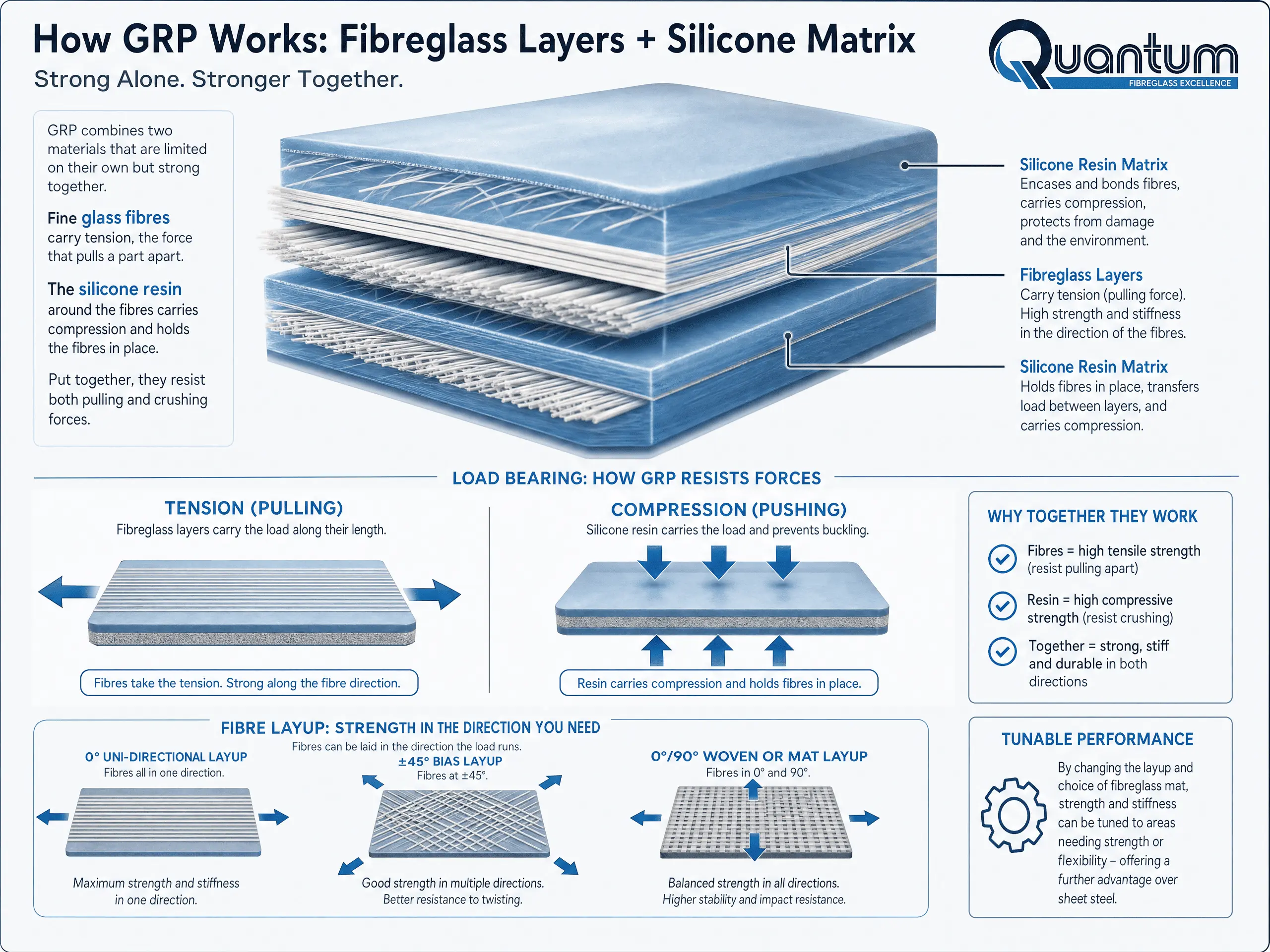
GRP combines two materials that are limited on their own but strong together. Fine glass fibres carry tension, the force that pulls a part apart. The resin around the fibres carries compression and holds the fibres in place. Put together, they resist both pulling and crushing forces.
This matters for the strength question, because GRP has no single strength figure. The fibres can be laid in the direction the load runs. This means the material can be tuned for a stiff panel or a flexible cover. You can read more on how we build up fibreglass and how the layup changes the result.
How Strong is GRP? In Numbers
The lack of a single figure is exactly why GRP can be made strong enough. The glass carries the load, so the more glass a part holds and the better the fibres line up with the force, the stronger it is.
- In bending, a GRP laminate can reach around seven times the flexural strength of steel for the same weight.
- A typical hand-laid laminate measures around 68 MPa in tensile strength and 125 MPa in bending, which comfortably suits covers, housings and panels.
- Adding more glass layers, heavier reinforcement or a core material raises strength and stiffness where a part needs it.
So the real question is not whether GRP is strong enough in general, but how strong the specific industrial part needs to be. The laminate is built to match.
GRP Density and Strength-to-Weight
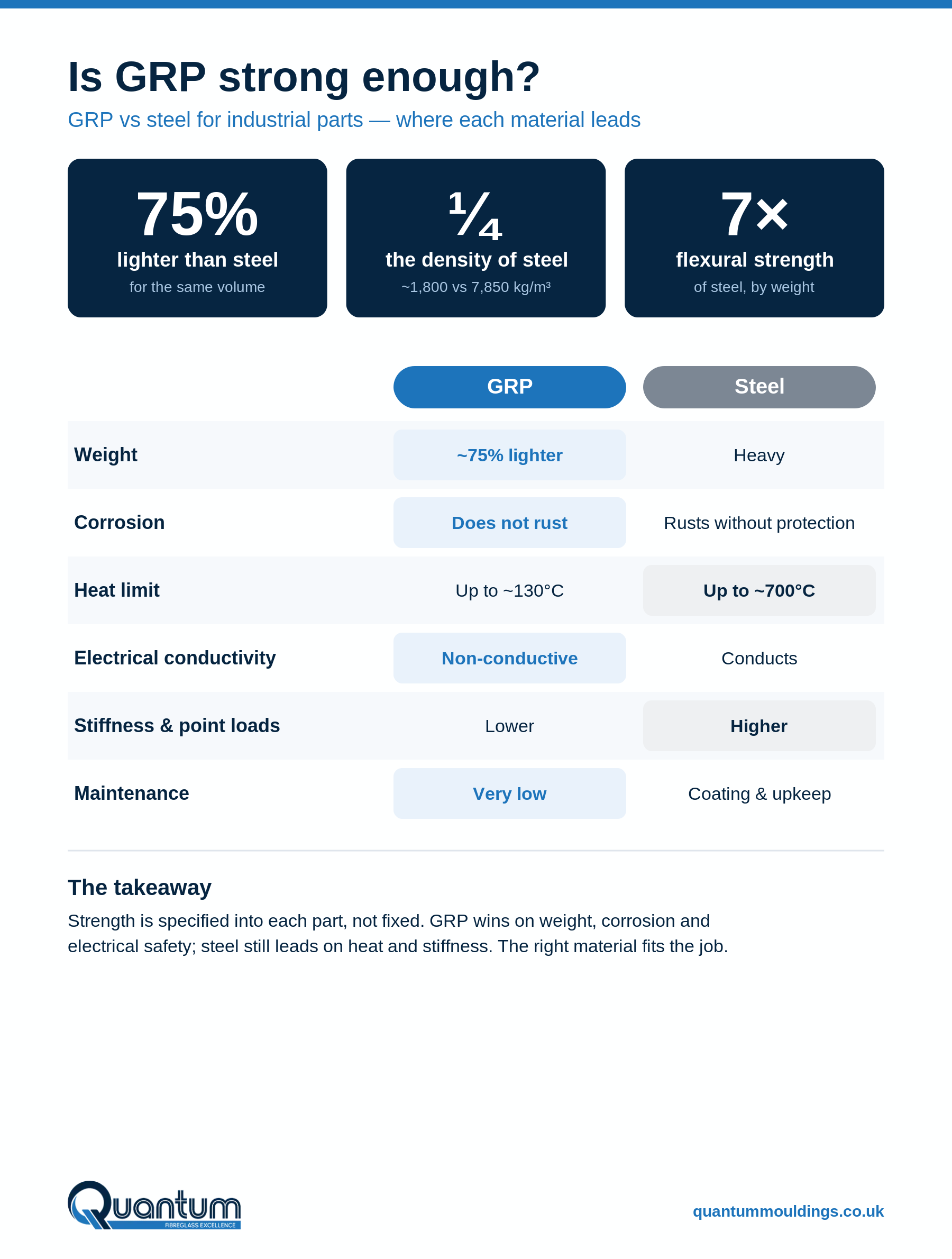
GRP wins on strength per kilogram rather than strength per millimetre. It has roughly a quarter of the density of steel and is about 75% lighter for the same volume. By weight, glass-reinforced plastic sits near 1,800 kg per cubic metre, against aluminium at about 2,700 and steel at about 7,850.
For an industrial buyer, that weight saving is practical. Parts are easier to lift and fit, mounts and frames can be lighter, and transport costs drop. On moving equipment such as excavators, less weight means less fuel.
GRP versus Metal
GRP does not beat metal at everything. Here is where each material leads.
| Measure | GRP | Steel |
|---|---|---|
| Weight | About 75% lighter | Heavy |
| Corrosion | Does not rust or corrode | Rusts without protection |
| Heat limit | Up to about 130°C | Up to about 700°C |
| Electrical conductivity | Non-conductive, insulating | Conducts |
| Stiffness and point loads | Lower | Higher |
| Maintenance | Very low | Needs coating and upkeep |
The headline trade-off is heat and stiffness against weight and corrosion. Where a part faces sustained high temperatures or very high point loads, steel still earns its place. Where weight, rust and electrical safety drive the choice, GRP is the stronger option. Against aluminium, GRP is lighter again and does not corrode, though aluminium is stiffer.
Strength is Specified, not Assumed
Because strength is built in, the resin, the glass and the way the part is made are all chosen to suit the job. Polyester resin suits general work, vinyl ester handles chemicals and water better, and epoxy gives the highest performance. The glass can be chopped strand for complex shapes, woven cloth for higher strength, or fibres run in one direction where the load is one-way.
The finish is specified too. Quantum starts every part with the mould and the gelcoat, the coloured outer layer that gives the surface its look. Gelcoats can be matched to almost any colour and applied by hand or spray, and a good one matches the gloss of a painted finish, so a part can be strong and look right at the same time.
Quantum makes every part to unique dimensions, not from standard profiles, using three laminating routes that differ in strength:
- Hand lamination lays controlled-thickness glass mat into the mould by hand. It gives tight control over thickness and lets reinforcement go exactly where the load is, which makes it strong and well suited to complex parts.
- RTM (Resin Transfer Moulding) uses a closed, two-part mould. It gives the most consistent thickness and glass content, so its strength is the most repeatable of the three, with a smooth finish on both faces.
- Spray lamination sprays chopped glass and resin into the mould. The shorter, random fibres usually give lower mechanical strength than hand lay or RTM, so it suits larger, less heavily loaded parts where speed and cost matter.
Quantum matches the laminating method to the part, using RTM Lite where strength needs to be most consistent, all backed by in-house engineering.
How we know a part is “strong enough”
"Strong enough" is measured, not claimed. Material can be checked by set tests for tensile strength, bending, the bond between layers and water absorption, and it can be specified to BS 476 Part 7 or other alternatives for fire where the product requires it.
A handmade part also has to be consistent from one to the next. Quantum works to ISO 9001 with approved process sheets, thickness checks and pre-delivery inspection, so the part you approve is the part you keep getting. There is more on how we hold quality.
When GRP is the right choice, and when it is not
GRP is the right call for parts that face corrosion, need to be light, have complex shapes, must not conduct, or run in low to medium volumes.
GRP may not be suitable where a part:
- sees sustained high heat, typically above 120°C
- needs very high stiffness or point-load strength
- or sits in water long term with the wrong resin, which can cause blistering
Also, GRP cannot rescue a structure that has already lost its integrity. Being clear about these limits is part of choosing the right material.
GRP in industrial parts
In industrial settings, there are two main uses for GRP. Machine and equipment covers take advantage of the strength-to-weight ratio, the complex shapes and the clean finish. Enclosures and housings benefit from the corrosion resistance and electrical insulation for cabinets, kiosks and equipment housings. Both are everyday GRP parts, and both show the material doing a job metal would struggle with.
Talk to Quantum about your part
GRP is strong enough for most industrial components when it is specified properly. The honest answer to "is it strong enough" is always "for this part, made this way." If you have a machine cover, an enclosure or another custom part in mind, talk to Quantum about whether GRP is the right material and how we would build it.
FAQs
Is GRP as strong as steel?
For its weight, yes, and in bending it can exceed steel. Steel is stiffer and handles point loads and heat better, so the right choice depends on the part.
How heavy is GRP compared with steel and aluminium?
GRP is about 75% lighter than steel for the same volume and lighter than aluminium too, while not corroding.
Does GRP fail in heat?
Standard GRP works up to about 120°C. Above that, steel is the better material unless a special resin is specified.
How long does GRP last?
With the right specification, a GRP part often lasts for decades with very little maintenance and no rust.
Is GRP strong enough for structural use?
GRP can be engineered to carry structural loads. Quantum makes custom moulded and laminated parts, such as covers, enclosures and housings, specified to the loads each part will see, rather than standard structural sections.